Sunday, June 14, 2015

Murdoch to step down as 21st Century Fox chief executive

Rupert Murdoch is preparing to step down as chief executive of 21st Century Fox, sources close to the company say.
His son James will take over the role, while his other son Lachlan will become executive co-chairman.
The 84-year-old Rupert Murdoch will remain as executive chairman at the company and still have the final say in matters.
The company said the matter of succession would be discussed at the next board meeting.
It would not comment further.
James Murdoch, 42, has been acting as co-chief operating officer at Fox after leaving his job running BSkyB. His new role will entail running the day-to-day business of Fox.
As executive co-chairman, Lachlan will effectively be James' boss.

Analysis: Robert Peston, BBC economics editor

What do these changes all mean?
First and foremost it does not mean Rupert Murdoch is bowing out.
He, too, will be an executive co-chairman.
And I am told that he will continue to be the most powerful individual in the sprawling entertainment empire.
But it will represent the latest stage in the rehabilitation of James Murdoch, whose reputation was damaged by his stint as head of News Corporation in Europe and Asia when the News-of-the-World phone hacking scandal broke.
However, it also shows that Lachlan will probably end up as the most powerful of the Murdochs - as and when Rupert Murdoch stands down - which, according to those close to him, is as remote a prospect as ever.


A new wedding trend? The men taking their wives' names


The 32-year-old music promoter from Glasgow, Scotland, says he didn't think anything of it.
"I really liked the sound of my wife's name - Rowan Martin - and didn't want to spoil that with her changing it."
At the beginning, Ben's sister had some concerns it would be the end of the line for the family name, but she was soon won over. "I explained to her, 'what's in a name', it doesn't really matter. It wouldn't make a difference," he said.
"It shows I don't buy into this idea of patriarchy, and that I'm comfortable enough with who I am that I don't see it as anything at all."
It's difficult to know how many other men are following Ben Martin or Marco Saldana's lead because all of the research into married names focuses on a woman's decision.
A 2013 survey of 13,000 brides for the wedding website topknot.com found that the vast majority (80%) of females still choose to take their spouse's last name, although the numbers are falling as more retain their maiden name.
Claudia Goldin, a Harvard economist who co-authored a 2004 study into the subject, says her research showed a rise in college-educated women keeping their surnames from the mid 1970s onwards, corresponding to the rise of feminism, and as women began to make a professional name for themselves. In the 1990s the pace of change slowed down, as more women stuck with tradition.

"The reason for the decrease in surname-keeping in the 1990s is not clear," says her report, "We can only speculate about the social factors that have caused surname-keeping to decrease... Perhaps surname-keeping seems less salient as a way of publicly supporting equality for women than it did in the late 1970s and 1980s,"
For the women who hang onto their surnames, the decision is often practical. Silicon Valley based psychologist Kathryn Welds says as more women work, their desire to retain a "personal brand" has grown.
But where does that leave the men who are changing? Welds says she only knows of two who've taken their spouse's name. "In both instances these men had distant relationships with their fathers and didn't feel positively towards them," she says.
And like most things in marriage, there's also the compromise option. Welds is also seeing more couples merging their surnames together to create a hybrid.
When BBC producer Andy Brown married Helen Stone, they became the Brownstones.
"Helen is one of two girls. Her sister was already married and had taken her husband's name," he says. "She didn't want the Stone to disappear and the name Brownstone just seemed to work.
"Helen and I also liked the idea of creating a new tribe."

Nestle challenges Maggi noodles ban


Nestle India has challenged a ban imposed by India's food safety regulator on its popular Maggi noodles.
The Food Safety and Standards Authority of India says tests have found instant noodles "unsafe and hazardous" and has accused Nestle of failing to comply with food safety laws.
Nestle said on Thursday that it had gone to the high court in Mumbai seeking a judicial review of the order.
The company insists the noodles are completely safe.
In a statement, Nestle India said it had approached the court "as part of the effort to resolve" the matter and was "raising issues of interpretation" of India's food safety laws.
The company said it was also challenging a separate order from the government of Maharashtra state, of which Mumbai is the capital.
Last week, Nestle began withdrawing the Maggi brand from stores, after regulators said they found higher-than-allowed levels of lead in some packets.
On Thursday, it said it was continuing to withdraw the product from store shelves despite the court action.
Nestle's global chief executive Paul Bulcke has asked to see the results of the laboratory tests and promised to return Maggi to store shelves soon.
Several states have also been testing the noodles for the chemical monosodium glutamate, widely known as MSG.
The instant noodles arrived in India in 1983 and can be found in corner shops across the country.

Venezuela in spat with Guyana over oil exploration


Venezuela's President Nicolas Maduro demanded on Tuesday that neighbouring Guyana stop oil exploration in a disputed offshore territory.
The exploration is being carried out by US oil giant ExxonMobil.
Venezuelan Foreign Minister Delcy Rodriguez called the exploration "a dangerous political provocation".
Venezuela has been claiming the disputed mineral-rich region west of the Essequibo river as its own since the 19th Century.

Ratcheting tensions

An international tribunal ruled in 1899 that the area formed part of Guyana, which at the time was a British colony.

Venezuela never accepted the ruling, arguing it was unfair.
On 20 May, ExxonMobil announced "a significant oil discovery" in the disputed area.
A week later, President Maduro issued a presidential decree claiming sovereignty of the disputed waters.
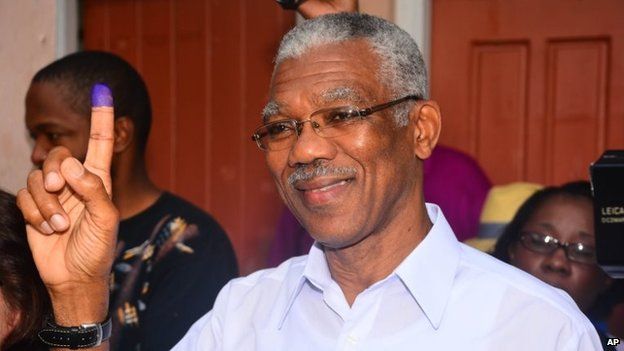
Guyana's newly elected President, David Granger, in turn released a statement on Sunday calling Venezuela's decree a "flagrant violation of international law".
He also accused Venezuela of wishing "to trample on the rights of a smaller country in order to obstruct the sovereign right of Guyana to develop its natural resources".
President Granger insisted that Guyana would continue to develop the offshore natural resources it considered its own.

'Bad advice'

On Tuesday, the Venezuelan leader blamed ExxonMobil for the diplomatic row.
He advised Guyana "not to take bad advice from ExxonMobil or from (local officials) bribed by Exxon Mobil".
Speaking on state television, he said that "with dialogue and diplomacy we should be able to iron our these historical differences".
Relations between Venezuela and ExxonMobil have been tense since 2007, when the country's then-president Hugo Chavez nationalised the company's assets.
Last year, an international arbitration tribunal ruled that Venezuela must pay ExxonMobil $1.6bn (£1bn) in compensation for the expropriated assets.

Greek debt talks 'must intensify'


The leaders of Greece, France and Germany have agreed to intensify negotiations with Athens' creditors, but there was little sign of progress.
After late night talks in Brussels, Greek Prime Minister Alexis Tsipras said all the sides would work to "bridge" remaining differences.
The EU and IMF want further economic reforms before they release €7.2bn (£5.3bn) of bailout funds to Athens.
Greece faces default at the end of June if it fails to repay €1.5bn to the IMF.
Earlier this week, Athens submitted a revised reform plan to the EU and IMF, after Mr Tsipras rejected a set of reforms put forward by EU Commission President Jean Claude Juncker.
It is believed Athens has conceded ground on VAT reforms, pensions and the country's primary surplus target.
Mr Tsipras is expected to hold further talks with Mr Juncker later on Thursday.

Eurozone warning

"We decided to intensify efforts to resolve the differences that remain and to move towards a solution," the Greek prime minister told reporters after his meeting with German Chancellor Angela Merkel and French President Francois Hollande.
"The European leaders realised that we must offer a viable solution and the chance for Greece to return to growth," Mr Tsipras added.
Ms Merkel and Mr Hollande left the talks without making public comments, however a German government statement said the three leaders had agreed that the negotiations "must be intensified".
The statement also said the meeting in Brussels was constructive.
In his comments, Mr Tsipras indicated he had stuck to his demand for some debt relief for Greece, the BBC's Damian Grammaticas in Brussels reports.
But European leaders will not countenance writing off debts before Greece commits to reforms. So there appears to have been little achieved and only a few more days for all sides to find a solution, our correspondent adds.
Last week, Greece "bundled up" a €300m payment to the IMF, delaying the payment until the end of June when a total of €1.5bn is due to be paid.
Mr Tsipras has warned earlier that a failure to reach a deal on Greece's bailout by the end of June would be the beginning of the end for the eurozone.

Australia PM Tony Abbott urges regional action against IS


Australian Prime Minister Tony Abbott has urged Asia Pacific nations to fight jihadist groups, saying Islamic State (IS) has global ambitions.
At a conference in Sydney on countering terrorist propaganda, he said IS was a death cult with far-reaching tentacles.
Australia says more than 100 of its citizens are fighting with militant jihadist groups in Syria and Iraq.
Last year, Australia raised its threat level to high and has conducted a series of counter-terrorism raids.
The two-day regional security summit includes ministers from 25 countries, including Malaysia, Singapore, Japan, Laos, Vietnam and New Zealand.
Representatives from Google, Facebook, Twitter and other social media sites are also attending.
"Daesh [IS] is coming, if it can, for every person and for every government with a simple message: 'Submit or die','" Mr Abbott said in his opening remarks. "You can't negotiate with an entity like this, you can only fight it."
"This is not terrorism for a local grievance, this is terrorism with global ambitions."

'Misguided'

Mr Abbott said the main challenge was working out how to stop young people from joining jihadists groups, which he said would be the work of the conference.
"We need idealistic young people to appreciate that joining this death cult [IS] is an utterly misguided and wrong-headed way to express their desire to sacrifice," he said.
Amid concern about the domestic impact of jihadist groups, Australia has introduced new national security measures including criminalising travel to terror hotspots and giving extra funding to police and security agencies.
The government recently announced plans to table law to remove citizenship from dual nationals who support extremist groups.
Mr Abbotts remarks come after US President Barack Obama approved sending up to 450 more military personnel to Iraq to train forces fighting IS.

Fatal A400M crash linked to data-wipe mistake


A military plane crash in Spain was probably caused by computer files being accidentally wiped from three of its engines, according to investigators.
Plane-maker Airbus discovered anomalies in the A400M's data logs after the crash, suggesting a software fault.
And it has now emerged that Spanish investigators suspect files needed to interpret its engine readings had been deleted by mistake.
This would have caused the affected propellers to spin too slowly.
The aeroplane crashed near Seville, during a test flight on 9 May, killing four crew members on board.
Several countries that had already accepted deliveries of the plane - including the UK - grounded them following the accident.
However, Airbus has announced it plans to fly one of its own A400M aircraft at the Paris Air Show next week.

"We have complete confidence in the A400M, and we are delighted to fly our demo as planned," said Airbus executive Fernando Alonso in a statement.

Stuck in idle

It said the focus of the inquiry was a theory that files known as "torque calibration parameters" had been accidentally deleted during a software installation process ahead of the plane's first flight.
A source later confirmed this to the BBC.
The control systems of the A400M aircraft are heavily automated.
Each engine is run by a separate computer called an Electronic Control Unit.
The ECUs take the pilot's inputs and make the engines they control respond in the optimum way.
The parameter files are used by the ECUs to interpret sensor readings about the turning force generated by each engine - the torque - which is used to make the attached propellers spin.
Without the files, the ECUs cannot make sense of this data.
This would explain why three of the plane's four engines did not respond properly to the crew's attempts to adjust their power settings shortly after take-off.
Airbus has already confirmed that its pilots had tried switching the malfunctioning engines into "flight idle" mode - their lowest power setting - in an attempt to tackle the problem.

Without the parameter files, the engines would have been left stuck in this mode.
This is because the planes were deliberately designed to prevent out-of-control engines powering back up, to avoid them causing other problems.
It was not foreseen that three propellers would be affected simultaneously, making it impossible to keep the plane airborne.
"We are working closely with the official investigation, and we will act in accordance with the information that is discovered but are not able to discuss the findings," a spokesman for Airbus told the BBC.
Spain's Ministry of Defence, which is leading the investigation, has said it is not permitted to discuss the matter.

Grounded planes

A400M planes were created to give Europe's Nato partners independent access to heavy aircraft to transport troops and large weaponry.
The UK, France, Malaysia, Turkey and Germany have already taken deliveries of the plane.
The accident involved a model built for the Turkish Air Force.
While the investigation continues, Spain has prohibited Airbus from flying other new A400M planes, meaning it cannot carry out the test flights required for dozens of uncompleted orders.
The longer the inquiry continues, the greater the financial consequences will be, as Airbus will not be paid until those deliveries occur.
Airbus was already under pressure because the A400M project is years behind schedule and hugely over budget.
The company can, however, continue to fly its own existing "development" A400M aircraft.
It will be one of these planes that appears at the air show in Le Bourget next week.